
Lately I have been giving a lot of thought to futuring. I am not a futurist, but I have done a fair bit of reading and thinking about this topic because it is so related to both evaluation and to the behavior of complex systems. I decided to put my thoughts out there so that people could point out the errors of my ways. At some point I will add references, tighten the argument, and transform this post into an article for an academic journal. But in the meantime, here are my musings.
There is a lot of effort in the field of evaluation to engage in futuring exercises. These efforts make sense because our customers ask for help in deciding what programs to implement, how they should be designed, what services they should provide, and what outcomes to pursue. We also spend a lot of time trying to identify what outcomes will be generated by the programs we evaluate. Of course we are exquisitely aware of the likelihood of unforeseen consequences. Still, building an awareness of likely outcomes is important to us. Because futuring matters in our work, we need to think about what futuring exercises can and cannot tell us.
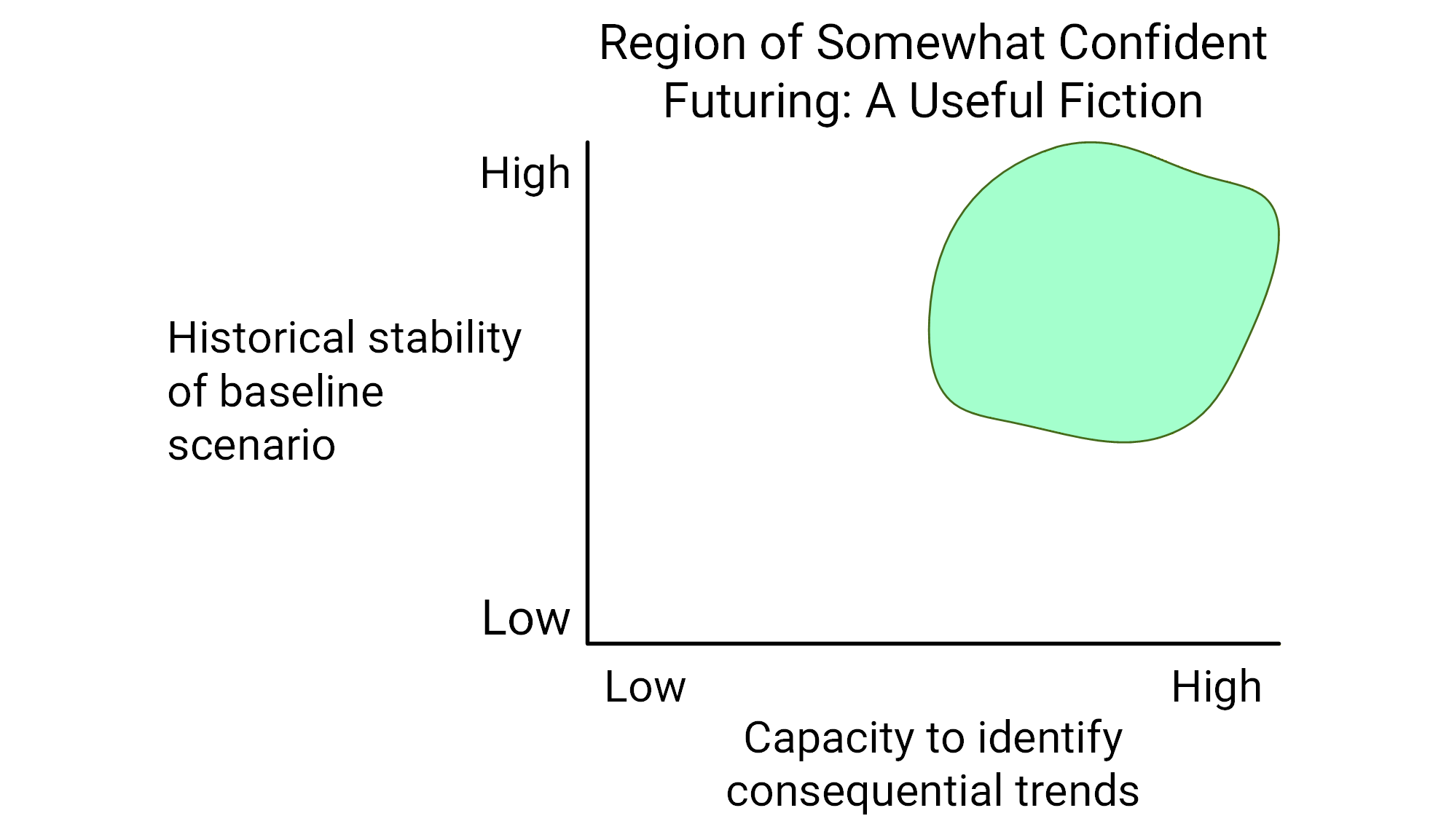
I see two genre of futuring. One is based on the belief that however uncertainly, we can envision a future and plan to get there. I call this the “Locksley Hall” approach, after a line in Tennyson’s poem Locksley Hall “For I dipt into the future, far as human eye could see, / Saw the Vision of the world, and all the wonder that would be.” The second genre relies on the behavior of complex systems and is much less sanguine about futuring. We plan; God laughs.

 Evaluation Uncertainty