
Messages in Connections Among Model Elements
Abstract
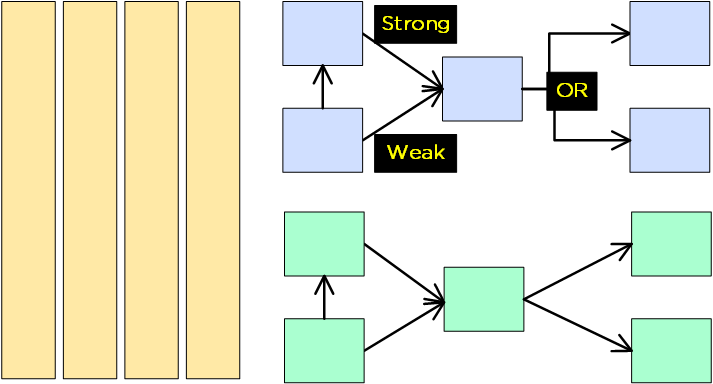
This is the second of two blog posts on the logic in logic models. This one recapitulates and extends the content of the first. (Go here for Part One.) The title of this post uses the term “logic model” but I transition to “model” to reinforce the idea that what we call “logic models” are actually models to drive inquiry, and models in that sense have a considerable epistemological literature. I discuss three levels of model specificity. The first is the siloed model that is specific only at a high level of abstraction (e.g., outputs à outcomes). This model form lists, but does not specify relationships among elements within each high-level category. The second form is the “box and arrow” layout that is so common in evaluation. The third adds to the “box and arrow” form with additional information on relationships, e.g., designations of how strong or likely relationships are likely to be. We know less about how programs work and their consequences than we think we do. Therefor while more detail and information in a model is desirable, extreme caution is needed when moving from higher to lower levels of detail. As long as we use models exclusively for evaluation purposes, there is no reason to reach consensus on a single model. Beliefs about program operations and impacts can differ, so there can be every reason to test multiple models. Models with different levels of specificity in different regions can be practical and necessary. Practical because we may know more about one region than another. Necessary because if complex system behavior is involved, it may be impossible to drive the model to a low level of specificity. Blog posts I plan (but do not promise) to write in the future are: 1) mixing specificity and ambiguity in a single model, 2) models that exhibit complex system behavior, and 3) implications of using models for different purposes.

 Evaluation Uncertainty